

Africa loses $5 billion to cybercrime annually, yet its digital economies continue to scale faster than the defences protecting them. In East Africa, mobile money transactions in Kenya alone now exceed 53% of GDP, exposing just how much financial infrastructure has outpaced security readiness. Across the region, 74% of organisations rank cyber risk as a top priority, but only 29% run the crisis simulations needed to survive a real breach.
Smartcomply, a leading provider of automated, AI-powered compliance and cybersecurity solutions, has released its latest research report, AI & the Cyber Frontier: Securing East Africa’s Digital Future, in partnership with TechCabal Insights, the data and intelligence arm of pan-African publication TechCabal.
The report highlights how East Africa’s digital economy has moved from experimentation to infrastructure. In Kenya, more than 90% of adults are enrolled in a digital identity system, making identity infrastructure central to financial access and public services. Notably, AI is embedded in fraud detection, credit scoring, customer service, and authentication workflows. But as digital infrastructure scales, so does systemic risk.
Key findings from the report:
The hidden risk layer: APIs and aggregation: As fintechs, banks, telcos, and government services increasingly integrate through APIs, cyber risk no longer sits inside a single organisation. A vulnerability in one integration layer can expose multiple institutions simultaneously, turning what used to be isolated incidents into ecosystem-level risks.
One of the report’s most revealing data comparisons illustrates this clearly.
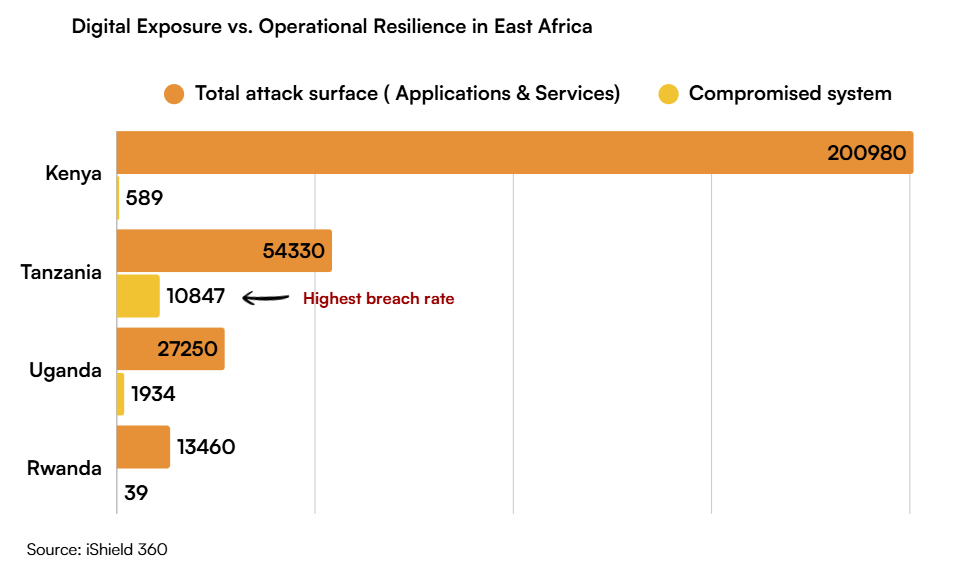
Although Kenya carries the region’s largest exposed digital attack surface, it maintains a relatively low compromise rate (0.3%) while Tanzania, with a smaller footprint, experiences significantly higher failure rates (20%). The implication is clear: digital scale alone does not determine risk; defensive maturity does.
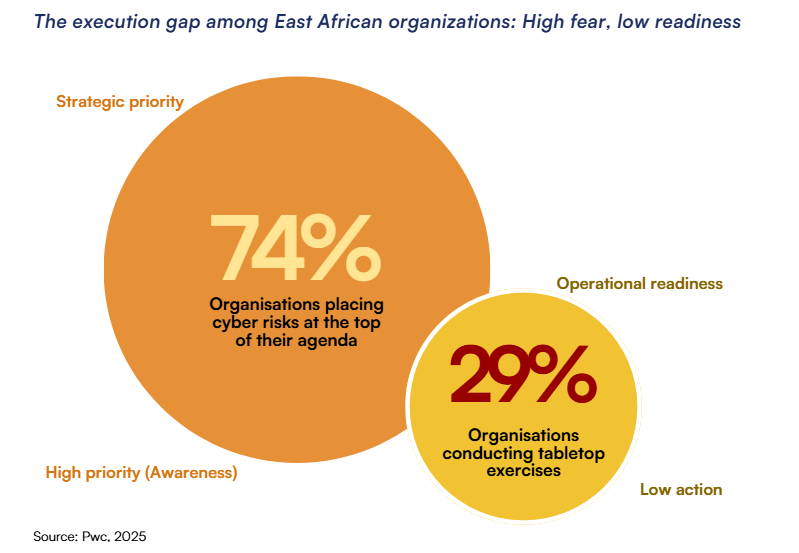
The execution gap: high awareness, low preparedness: While 74% of East African organisations rank cyber risk as a top strategic priority, far exceeding the global average of 57%, only 29% actually conduct crisis simulations or tabletop exercises necessary to survive a real-world breach.
AI accelerates cyber risks faster than defences can adapt: On one side, organisations deploy machine learning to flag suspicious behaviour and automate detection. On the other, attackers use automation to scale phishing campaigns, refine social engineering, and chain attacks across integrated systems. “Artificial intelligence has fundamentally changed both the velocity and the veracity of the threats…it has lowered the threshold for actually being able to execute a cyber attack,” said Tim Theuri, CISO M-PESA Africa.
The shift from “breaking in” to “logging in”: Attack patterns are also evolving. Phishing, SIM-swap fraud, password stealers, and account takeovers increasingly target identity systems rather than infrastructure itself. East Africa records the continent’s highest fraud rejection rate at 27%, reflecting sustained pressure on digital identity and onboarding systems.
What this means for East Africa’s next phase:
- Trust is the real stake, as fintech deepens, AI adoption expands, and cross-border digital trade accelerates, resilience will determine sustainable advantage.
- Regulators must move from compliance to stress-testing, the next frontier is system-level simulations across banks, telcos, fintechs, and public agencies.
- Boards and operators must operationalise cyber governance, identity-layer security, API risk management, quantified cyber exposure, and routine incident rehearsals, which must shift from reactive crisis tools to embedded governance discipline.
- Capability is the ultimate constraint: With 82% of African organisations facing a shortage in AI and cyber talent, the highest share globally, investing in human capital is non-negotiable.
As Gbemisola Osunrinde, CEO of Smartcomply, notes: “Resilience improves when organisations plan for failure instead of assuming stability. The shift from reactive fixes to deliberate design is what ultimately builds long-term trust”.
East Africa has proven it can scale digital infrastructure faster than most emerging markets. The next challenge is ensuring that cyber resilience scales just as quickly.
Download the full report: AI & the Cyber Frontier: Securing East Africa’s Digital Future Report