


Much of Africa’s tech coverage follows the money. This edition looks at a different part of Africa’s tech ecosystem —one shaped as much by institutions as by technology.
In 2008, amid post-election violence in Kenya, four technologists built Ushahidi, a tool that let ordinary people report what was happening around them, in real time, when the state couldn’t respond.
That moment established civic technology as infrastructure for participation, a way to close the gap between citizens and the state.
We mapped 219 organisations carrying that idea forward today.
Civic Tech Is No Longer Experimental
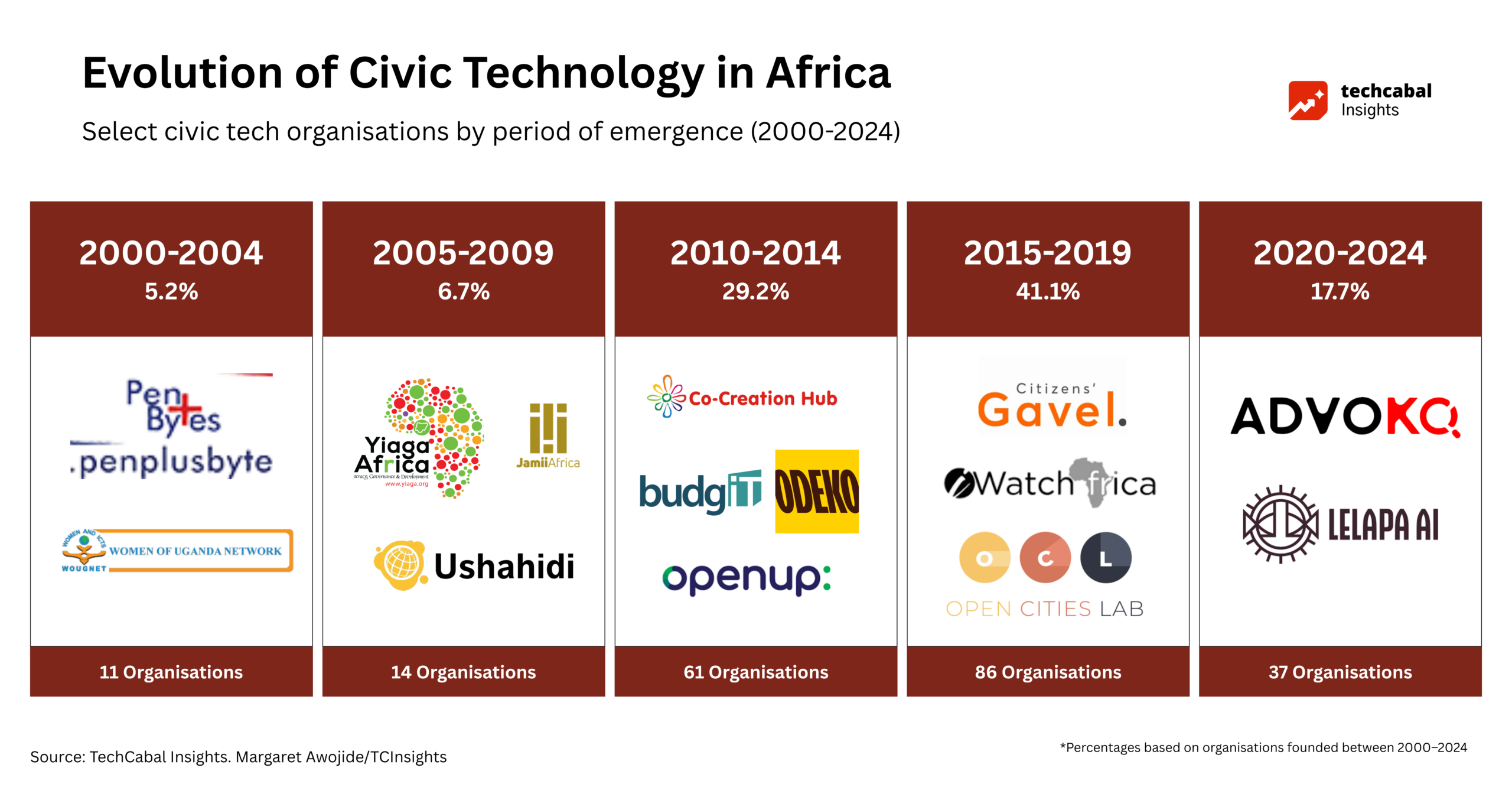
Civic technology has been scaling quietly across the continent. Our analysis of the ecosystem identified 219 civic tech organisations across Africa, with more than two-thirds founded between 2010 and 2019.
This growth reflects broader shifts. Internet access has more than doubled over the past decade. Mobile penetration has increased significantly. Innovation hubs have also expanded across key markets.
Civic tech becomes most visible during moments of pressure: elections, crises, and public health emergencies.
During COVID-19, as emergency funds flowed into Nigeria and other countries, concerns grew over how those funds were being used.
BudgIT’s COVID-19 Transparency and Accountability Project (CTAP) built platforms to track relief spending, turning fragmented budget data into something accessible and verifiable.
Following this, Nigeria’s Federal Ministry of Budget published a detailed breakdown of COVID-19 expenditures.
But Growth Is Deeply Uneven
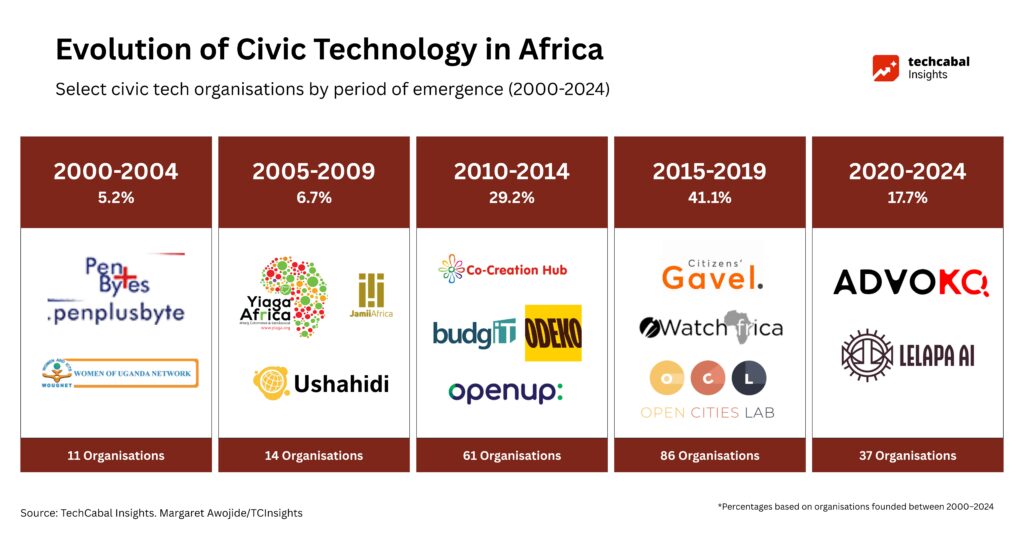
This growth does not tell the full story. The ecosystem is expanding, but not evenly. Activity is still heavily concentrated in a small number of countries.
Based on organisation headquarters, Nigeria accounts for 25% of mapped organisations, followed by South Africa (21%) and Kenya (12%). Together, these three countries represent more than half of the ecosystem.
By contrast, North and Central Africa remain underrepresented, each accounting for less than 5% of mapped organisations.
This funding is often project-based and time-bound, tied to donor priorities rather than long-term organisational needs. When funding cycles end, many organisations struggle to sustain operations.
The Real Constraint Isn’t Technology — It’s Power
Infrastructure matters, but it is not the main constraint.
Most African countries fall into the “obstructed”, “repressed”, or “closed” categories on the CIVICUS civic space index.
These are environments where restrictions on speech, internet shutdowns, and pressure on civil society are common.
These conditions shape where civic tech can operate and whether it can scale.
Funding adds another constraint.
The ecosystem is heavily dependent on international donors — foundations, bilateral agencies, and multilateral organisations.
Builders Are Adapting
Despite these constraints, the ecosystem is adapting. Civic tech in Africa is built for inclusion. It is designed to meet people where they are, not where the builder feels most comfortable.
Lower-tech channels like SMS, USSD, and WhatsApp remain critical for reaching users who would otherwise be excluded.
What civic tech can achieve in Africa will depend not just on technology, but on whether the environments it operates in can support it.
Stay Ahead With TC Insights Pro
Get exclusive research and data for Africa’s tech industry, with deep market intelligence, sector reports, and early access to new features.