


Africa’s electric mobility transition is not being led by cars, highway charging corridors, or luxury EVs. It is unfolding through something far more familiar to everyday life on the continent: motorcycles and tricycles. In many African cities, two- and three-wheelers move 60–75% of motorised passengers and goods, making them the backbone of urban mobility and informal commerce. That is why Africa’s most consequential EV shift is happening on two wheels, not four.
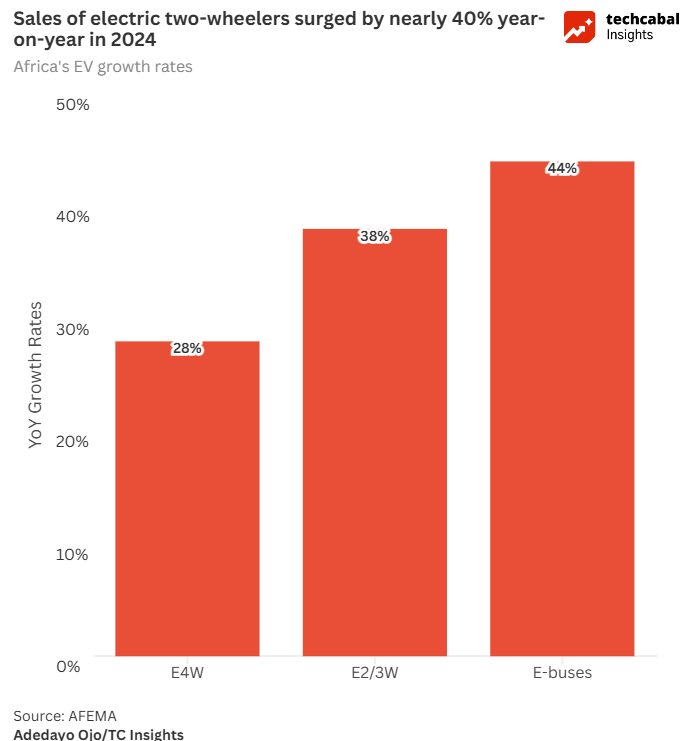
In 2024, sales of electric two-wheelers surged by nearly 40% year-on-year, with 9,000 units hitting the road. While this volume currently represents a 0.5% share of the continent’s total annual motorcycle sales, the momentum is accelerating as regional leaders like Spiro, Roam, and Ampersand scale manufacturing and battery-swapping infrastructure across the continent. With electric motorcycles still accounting for less than 1% of Africa’s estimated 30–40 million vehicle fleet, the current trajectory indicates how early and how vast the opportunity is.
Driven by rising fuel costs and the rapid expansion of battery-swapping networks, Africa’s e-mobility transition offers superior unit economics and greater inclusivity than the passenger-heavy models of Europe or China. By prioritising low-cost, high-utility two-wheelers, the continent is bypassing the traditional luxury EV trajectory to build a cleaner, mass-market mobility engine.
Why two wheels, not four? The economics are unmistakable
In Sub-Saharan Africa (SSA), motorcycles are more than vehicles; they are essential income-generating assets that anchor urban mobility. In major hubs like Lagos, Kigali, Nairobi, Kampala, and Accra, commercial riders currently operate on a razor-thin margin, often spending between 35–45% of their daily earnings on petrol. This cost structure has become increasingly unsustainable, particularly following Nigeria’s 2023 fuel subsidy removal, which led to average pump prices surging by over 210% in a single year.
Electric motorcycles are fundamentally disrupting this economic equation by drastically lowering operational overhead. In Rwanda, riders utilising Ampersand’s e-motorcycle fleet report annual savings of approximately $700, driven by a 45% reduction in fuel and maintenance expenses. Similarly, Kenyan operators like Roam and Ecobodaa have demonstrated that the Total Cost of Ownership (TCO) of electric bikes is 30–40% lower than that of petrol counterparts. For a commercial rider typically earning between $5 and $10 a day, these marginal gains represent a transformative income boost, reframing e-mobility as a critical livelihood strategy rather than just a climate initiative.
The data highlights that while the initial purchase price of an electric vehicle remains higher, the massive long-term savings in energy and maintenance result in a 31% lower TCO over a three-year period for a commercial rider. This advantage is illustrated in the comparison below, which highlights why the transition to two wheels is now a financial imperative for the continent’s transport workforce.
ALSO READ: Spiro raises $50 million to scale battery swapping network
Battery swapping: Africa’s breakthrough model
Africa’s EV shift is jump-starting a business model that global markets are now watching: Battery-Swapping-as-a-Service (BaaS). As of early 2026, the sector has transitioned from experimental pilots to infrastructure-grade rollouts, with institutional capital favouring asset-backed models that solve the continent’s unique energy challenges.
In early 2026 alone, African e-mobility startups have secured over $75 million in funding, signalling a decisive shift toward large-scale, infrastructure-style debt. This momentum is led by Spiro’s $50 million debt facility to expand its 2,500-station network and MAX’s $24 million raise to finance 120,000 EVs. Ampersand also raised a $7 million round in late 2025 to scale its fleet to 13,000 motorcycles by late 2026.
Why the BaaS model is winning
- De-risked CAPEX: By removing the battery, the vehicle’s most expensive component from the initial purchase, BaaS startups are slashing entry costs for commercial riders.
- Efficiency: With swaps taking under five minutes, riders eliminate range anxiety and charge-time losses, maintaining the high daily mileage required for commercial profitability.
- Predictable revenue: Operators like Spiro, which recently secured $50 million in debt to expand its 2,500-station network, treat batteries as circulating energy assets that generate recurring fees similar to traditional petrol sales.
ALSO READ: Ampersand alone aims to deploy 40,000+ electric motorbikes by 2026 in East Africa.
The “Fuel Station” of the future
The infographic below breaks down the unit economics that make BaaS a sustainable, high-margin business for operators while providing affordable energy to riders.
East Africa: The continent’s living laboratory for E-mobility
East Africa has emerged as Africa’s leading e-mobility hub, due to progressive regulation, relative grid stability, and strong motorcycle taxi markets.
- Kenya: Hosts 50+ e-mobility startups, including Roam, Ampersand Kenya, Kiri EV, Stima, and Powerhive. The government aims for 100,000 electric motorcycles, supported by the National E-Mobility Policy (2024). Kenya Power plans 400+ charging and swapping stations by 2027.
- Rwanda: One of the earliest adopters of EV-friendly tax incentives. The government targets 30% electric motorcycle penetration by 2030.
- Uganda & Tanzania: Strong boda boda markets with notable pilots from Zembo (Uganda) and electric tuk-tuk operators emerging in Dar es Salaam.
West Africa: A high-growth frontier
West Africa lags slightly behind East Africa, but its scale makes it the region to watch.
- Nigeria: As Africa’s largest two-wheeler market with over 1 million motorcycles sold annually, the country is now experiencing a surge in electrification interest. Startups like MAX, Treepz, and Gricd are piloting green delivery fleets to offset rising operational costs. This momentum is anchored by the National EV Policy (2023), which provides strategic incentives for local EV manufacturing and imports to reduce foreign exchange pressure.
- Ghana: With Accra’s structured urban grid, Ghana is becoming a primary testing ground for battery-swapping models that require reliable density. To accelerate adoption, the government offers comprehensive VAT and import duty exemptions on EVs and is currently piloting assembly plants for electric buses to decarbonise public mass transit.
Morocco & Egypt: The manufacturing gateways
Morocco is leveraging its position as Africa’s leading passenger vehicle exporter, surpassing one million units produced in 2025. The Kingdom aims for 60% of its vehicle-production capacity to be electric by 2030 and has secured a $5.6 billion battery gigafactory set to begin production in 2026, providing the critical component backbone for the region’s emerging electric scooter and motorcycle fleets.
Simultaneously, Egypt is aggressively localising EV assembly under its National Automotive Manufacturing Programme. While focusing on passenger cars, the government is also phasing out traditional three-wheelers (tuk-tuks) in favour of electric alternatives and has already launched locally-made electric motorcycles like the Kader, priced at approximately $1,800, to promote affordable, eco-friendly transportation and reduce reliance on fossil fuels.
South Africa: The policy pivot
As the continent’s industrial leader, South Africa is transitioning from internal combustion engine (ICE) production to a green automotive hub. Beginning March 1, 2026, the government will introduce a landmark 150% tax deduction for capital investments specifically for EV and hydrogen production. New consumer incentives, including subsidies of up to R60,000 (~$3,300) for first-time buyers, aim to increase the penetration of Battery Electric Vehicles (BEVs) and Plug-in Hybrid Electric Vehicles (PHEVs)toward a 30% sales target by 2030.
Bridging the adoption gap: real barriers to entry
Despite the $75 million in funding secured by e-mobility startups (Spiro and Max) in early 2026 alone, the transition faces critical structural headwinds that prevent a “one-size-fits-all” rollout:
Infrastructure and Grid Reliability: Outside of stable pockets like Rwanda and Kenya, grid instability and “load shedding” in markets like South Africa necessitate a costly shift to off-grid, solar-powered charging to ensure uptime.
Fiscal and Financial Hurdles: High upfront costs are exacerbated by high import duties, such as South Africa’s 25% EV tax, and by a chronic lack of low-interest financing for independent commercial riders.
Regulatory and Technical Friction: Operators must navigate fragmented standards across 54 countries while managing accelerated battery degradation caused by tropical climates, which can strain the thin margins of the BaaS model.
The climate and public health dividend
The shift to electric two-wheelers is as much a public health necessity as it is an economic one. Currently, transport accounts for 10% of Africa’s CO₂ emissions (IEA). Motorcycles, especially older ones using low-quality fuel, are major contributors to urban air pollution. The environmental potential of this transition is grounded in data: electrifying just 10% of Africa’s motorcycle fleet would avoid 7–11 million tons of CO₂ annually.
Conclusion: The future of African mobility is light electric vehicles
Africa’s EV story will not mirror the car-centric models seen in Europe, China, or the United States. While the North and South build the heavy industrial base for four-wheelers, the immediate economic revolution remains on two wheels. For a commercial rider typically earning $5–$10 a day, the 31% lower Total Cost of Ownership (TCO) provided by electric models is a transformative livelihood strategy.