


Every year, Nigeria loses thousands of doctors to migration, with a total of 4,193 leaving in 2024 alone. This brain drain is often attributed to low remuneration, weak infrastructure, and challenging working conditions. However, data from an AI-powered exam-preparation platform, MyMedi8, used by doctors preparing for international licensing exams, suggests that the problem may also be linked to gaps in medical training.
Over 3,000 clinical practice sessions were analysed from 453 medical graduates. The sessions involved them taking patient histories, making diagnostic decisions, and managing treatment while observing ethical and interpersonal guidelines. The findings reflect a broader concern in medical education, with medical graduates being insufficiently prepared in communication and other non-technical competencies required for effective clinical care.
What the results say about medical training
These findings do not necessarily mean that Nigerian doctors lack competence. Rather, it may reflect differences in the structure of medical training locally compared with global licensing systems.
In many Nigerian schools, medical training typically emphasises theoretical knowledge and written examinations. Students spend years mastering clinical theory and coursework, but often have fewer opportunities to practice real-time clinical decision-making through simulation.
Ethical reasoning, patient communication, and consultation management are sometimes taught more as theory, but are rarely assessed through repeated clinical simulations. In contrast, many international licensing systems prioritise these skills, requiring doctors to demonstrate their application in practical situations. Candidates are evaluated not only on their diagnostic accuracy, but also on their ability to communicate risk, obtain informed consent, manage sensitive scenarios, and demonstrate professional judgement.
The brain drain connection
These gaps could also contribute to Nigeria’s brain drain, a phenomenon that requires further research. While migration is often linked to economic and systemic pressures, deficiencies in medical training may also play a role.
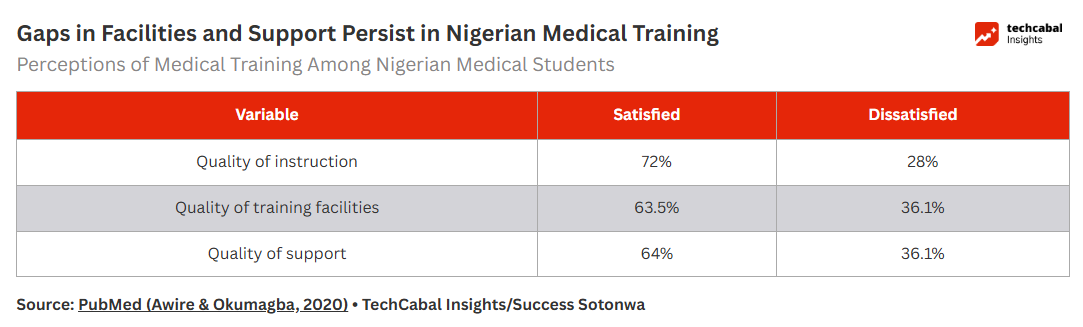
In a survey of 211 Nigerian medical students, 72% reported satisfaction with the quality of instruction. Over a quarter described it as “inadequate”, focusing on exam performance rather than comprehensive knowledge acquisition. Similarly, over a third of students were dissatisfied with the state of their training facilities. Students’ perceptions of both facilities and institutional support were significantly associated with migration attitudes.
These perceptions of training gaps, when compared with the structured expectations of international licensing exams and clinical practice frameworks, could reinforce the desire to practise in systems with more formal mentorship, structured clinical training, and professional development opportunities. Consequently, the migration of doctors reflects not only financial motivations but also differences between training environments and professional validation systems. Those who perceive stronger opportunities abroad are more likely to migrate.
What policymakers could learn from the data
The findings from this platform offer potential insights for policymakers seeking to reduce medical brain drain in the country. The focus should therefore extend beyond financial incentives and infrastructure improvements to include modernising medical education.
Medical training has increasingly shifted toward simulation-based learning. Where students regularly practice clinical consultations in controlled environments before entering real-world practice. Expanding training and evaluation techniques to go beyond what students know theoretically to how best they can apply knowledge in complex human situations is essential.
Teaching hospitals and medical schools could integrate simulation labs, structured communication assessments, and scenario-based ethics training into undergraduate and postgraduate programs. AI-powered platforms could also help provide multiple opportunities for medical students and junior doctors to practice complex clinical consultations repeatedly outside crowded hospital settings, something traditional clinical rotations cannot always guarantee.
Also Read: Future of digital health in Nigeria
Beyond the migration debate
Improving these competencies would not necessarily stop migration. But they could improve patient care outcomes and strengthen confidence in local medical education. It could also improve practical skills that are difficult to assess through written examinations. This will ensure that Nigerian doctors are trained in line with evolving global standards.
For a country facing both a growing population and a severe shortage of healthcare professionals, strengthening these foundations could be just as important as efforts to slow the exodus of doctors from its borders.
Explore data-driven insights in Africa’s Climatetech Capital Inflection Point