

By Tunde Alade-Bakare
Speed used to be the only religion in African fintech. Ship the product. Capture the market. Handle the regulators when they knock. For a while, it worked. It no longer does.
The companies genuinely winning today, the ones landing institutional capital, securing tier-one banking partnerships, and expanding into new markets without a legal crisis trailing behind them, are not necessarily the fastest builders. They are the most trusted. And trust, in this industry, is no longer built through marketing. It is built on compliance architecture, cybersecurity posture, and IT risk governance that can withstand scrutiny on the worst possible day.
Too Big to Manage Casually
According to data from the Nigeria Inter-Bank Settlement System (NIBSS), electronic payment transactions reached an all-time high of N1.07 quadrillion ($702.6 billion) in 2024, a 78% surge from 2023. The CBN’s 2025 Fintech Policy Report confirmed close to 11 billion electronic transactions were processed that year, placing Nigeria among the world’s leading real-time payments markets. The Agusto & Co. 2025 Fintech Industry Report recorded ₦52.3 billion in fraud losses across Nigerian financial institutions in 2024, a figure significantly skewed by a single ₦31.1 billion incident at one institution.
The more consequential data point is what came next: NIBSS figures for 2025 show fraud losses fell to ₦25.85 billion, a 51% decline, the direct result of stronger identity infrastructure and real-time fraud monitoring that compliant fintechs had already built. McKinsey estimates Africa’s financial sector absorbs more than $4 billion annually in cybercrime losses, growing faster than any other region globally. The companies that built compliance and security infrastructure before it was mandated are producing the better numbers. The ones that did not are still absorbing the cost.
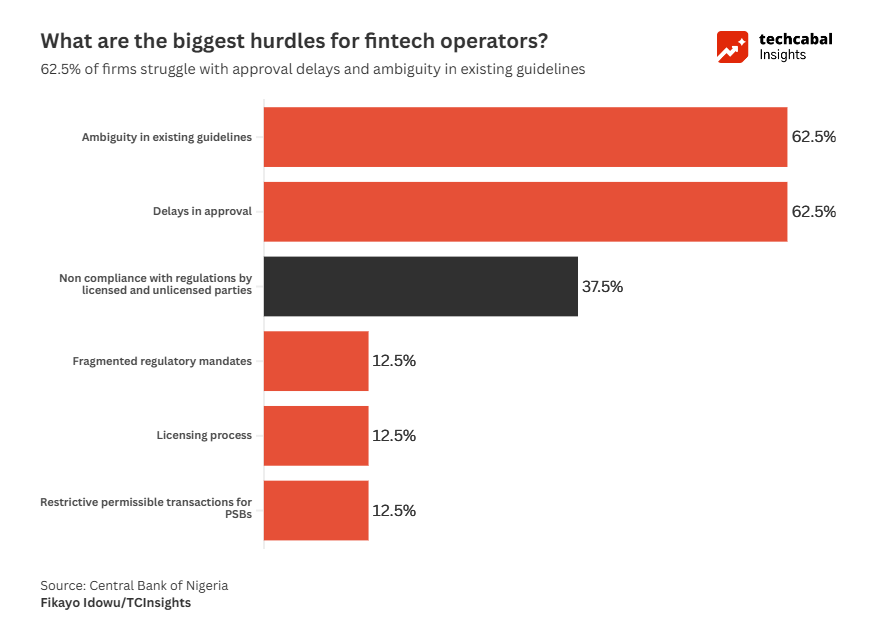
In March 2025, Paystack launched its Zap product in Nigeria without regulatory clearance. BusinessDay confirmed that the Central Bank of Nigeria issued a ₦250 million fine, citing that Paystack’s Zap operated as a deposit-taking wallet in breach of its switching and processing licence. What struck me about that episode was not the penalty itself. It was what it revealed, in the eyes of every counterparty that matters, a compliance failure and a security failure are now the same thing. Both destroy trust. Both close doors. Austin Okpagu, Nigeria Country Manager at Verto, framed it well: “The industry is entering an era of selective liberalisation, where firms that position themselves as partners in financial stability gain access, and those perceived as destabilising forces face tightening constraints.”
What changed after Paystack was not the rules. It was the infrastructure behind them. The CBN restructured its entire supervision model in Q1 2025, creating a dedicated Compliance Department that pulls financial crime, cybersecurity, and corporate governance under a single chain of command. That organisational decision matters because it signals intent; the CBN is no longer treating these as separate concerns that happen to live in the same building. It is treating them as one problem, because they are one problem. A company that manages fraud risk without managing cyber risk is not managing fraud risk. A company that ticks the governance box without documented data protection practices is not governing.
Getting It Right
JUMO is the clearest proof point I can offer. The AI-powered lender, operating across eight African markets, scored 92.2% in its customer protection assessment by Cerise+SPTF in July 2025, the first fintech ever assessed under the newly launched Digital Financial Services Standards, in a result described as unprecedented. What I find telling is that JUMO helped write those standards before volunteering to be assessed against them. It is not compliance—it is strategic ownership of the credibility framework that governs an entire sector.
The commercial consequences are direct. Credit scoring accuracy runs at close to 98%, with risk management costs below 4%. The company has disbursed $7.9 billion across 242 million loans to over 31 million customers. BlueOrchard’s $7.5 million securitisation commitment and the Orange Money Group partnership did not arrive in spite of that compliance posture. They arrived because of it. That is the distinction that changes how you should think about this entire space.
TymeBank planted its flag in South Africa, one of Africa’s most exacting regulatory environments, and turned that environment into its competitive argument. Transparency became the product: no hidden fees, account opening in under five minutes, credit methodologies documented and published annually. It became the first digital bank in Africa to reach profitability by December 2023 — within five years of launch. Fewer than 5% of digital banks globally can claim the same. Bloomberg reported that Nubank led a $250 million Series D, lifting the valuation to $1.5 billion. That is not just capital. It is a vote of confidence from the company that built Latin America’s most trusted digital bank on the same principles.
Moniepoint turned Nigeria’s licensing demands into infrastructure no competitor can easily replicate. Its 2025 Year in Review disclosed that its banking and payments subsidiary processed more than 14 billion transactions, with total value hitting ₦412 trillion ($294 billion). Eight out of ten in-person payments in Nigeria now run through its network. In a market still shaped by memories of platforms that failed their customers, that dominance belongs to a company that merchants actually trust. Visa’s strategic investment in January 2025 was a direct endorsement of that posture. Visa does not make infrastructure bets on compliance ambiguity.
ALSO READ: Nigeria exited the FATF grey list. Now it wants to set the rules for African fintech
Build for Trust or Be Left Behind
The character of capital flowing into African fintech has changed structurally. Development Finance Institutions (DFIs) and local banks now set the market’s floor. They deploy capital with environmental, social, and governance (ESG) and technology risk thresholds attached — non-negotiable. The IMF’s 2024 Global Financial Stability Report goes further: board-level cybersecurity governance directly reduces organisational risk. Institutional investors are now using that finding as a filter, not a footnote.
Regulatory licences, not customer base, drove the value of Africa’s most prized acquisitions in the 2025 consolidation wave. The licence is the asset. Compliance built it.
The threat environment makes this more urgent, not less. Generative AI-enabled scams surged 456% between May 2024 and April 2025, according to TRM Labs. Every fintech onboarding customers remotely across Africa is managing that reality today. Companies that invested early in compliance, cybersecurity, and IT risk governance are mitigating these threats as routine operational costs. For everyone else, they arrive as emergencies.
The message from the market is not subtle. If you are building a fintech in Africa and compliance, cybersecurity, and IT risk still sit in a back office rather than at the centre of your product strategy, you face more than regulatory exposure. You face irrelevance.
JUMO published a 92.2% customer protection score that no regulation required it to disclose. That is what building for trust looks like. The rest is a choice.
Tunde Alade-Bakare is a cybersecurity and technology transformation leader who has led major security programmes across financial services, telecoms, and digital platforms in Africa.
Get informed about African tech and where it is headed. Download the State of Tech in Africa 2025: Year in Review Report.