


In May 2024, the Biden administration brokered a $1 billion deal between Microsoft and UAE-based G42 to build a geothermal-powered data centre in Kenya’s Great Rift Valley. The overarching idea behind this deal was twofold: to strategically position Kenya as an anchor for East Africa’s AI ambitions and to check China’s growing digital influence in the region.
However, by August 2025, the project had still not broken ground. Kenya’s President, William Ruto, recently signalled that the project was unlikely to continue. “To switch on that one data centre”, he said, “we would need to shut off power for half the country. That’s when I knew there was a problem.”
The admission, an astonishing moment of clarity that appears reminiscent of buyer’s remorse, was a tacit acceptance that the government may have placed the cart before the horse. As Semafor reported, the government had to reconsider plans when it learned that the data centre would require at least a third of Kenya’s 3000 MW of installed capacity.
A similar stalling has affected Kenyan chipmaker Semiconductor Technologies Limited (STL). The company had thrived through a “friend-shoring” partnership with the United States, which granted it access to grants, discounted raw materials, and a market for its products. A change in administration meant reneging on those agreements, and a business now fighting for its survival.
None of this reveals anything new about Africa’s infrastructure deficits. Nonetheless, it exposes the fraught nature of a strategy that relies heavily on the promises of global superpowers without building a meaningful degree of sovereignty and self-sufficiency.
The infrastructure that isn’t
Africa holds less than 1% of global data centre capacity. Foreign servers, mostly in Europe, handle an estimated 80% of the continent’s internet traffic. South Africa, Kenya, and Nigeria together account for 41% of the continent’s 223 data centres, meaning the rest of the continent—35 countries and hundreds of millions of internet users—has fewer than 130 facilities.
Analysts valued the African data centre market at $3.49 billion in 2024 and project it will reach $6.81 billion by 2030. That growth rate looks impressive until you compare it to the scale of the problem. The Africa Data Centres Association estimates the continent requires at least 1,000 megawatts of new capacity across 700 facilities to meet demand. Achieving that would require roughly tripling the number of facilities, in an environment where reliable power is the exception rather than the rule.
To use an analogy, data centres are, in the AI era, what ports were in the colonial one. They are the chokepoints through which economic value flows and is extracted. The country that hosts compute shapes the inference. The company that owns the servers sets the terms. And right now, almost none of those servers are in Africa.
Two powers, one problem
Into this vacuum have stepped two competing visions, each with its own logic and its own costs for the countries being courted.
The United States, through its Digital Transformation with Africa initiative, has tried to mobilise private capital around strategic objectives—the Microsoft-G42 deal being the clearest example. Cassava Technologies has separately partnered with Nvidia to deploy GPU-powered data centres across the continent, hardware-first and designed to plug Africa into American-dominated cloud ecosystems.
China, through the Digital Silk Road, has moved faster and more cheaply. Huawei and ZTE have offered turnkey 5G networks and smart city infrastructure at prices reportedly lower than Western alternatives. Western governments, in turn, warn of data security risks embedded in Chinese-built hardware, valid concerns given Beijing’s national security laws, which can compel domestic firms to share data with the state.
Less acknowledged is that American cloud providers operate under their own government data-access frameworks, including the CLOUD Act. The choice between the two is less about dependency versus freedom than about two different foreign leverage arrangements.
What both powers share is a record of overpromising. Chinese smart city projects have stalled amid Beijing’s tightening economic constraints. American-backed hyperscale ambitions keep hitting the energy wall. African governments seeking genuine digital independence are now learning that you cannot outsource the building of critical infrastructure to superpowers; it merely relocates the dependency.
ALSO READ: The building blocks Africa needs for AI adoption
The sovereignty trap
African governments have reached for the most available tool: legislation. Nigeria’s National Data Protection Act of 2023 grants the state authority to designate data as having “strategic economic importance,” requiring sensitive categories to remain onshore. Kenya has adopted a mirroring model, mandating local copies of all personal data. The political logic is that if African data must stay in Africa, foreign cloud providers will be forced to build local infrastructure.
Yet, there’s a flip side. Forcing data localisation without adequate domestic infrastructure raises costs for everyone, including the local startups that African governments most want to nurture. In practice, it produces compliance bureaucracies that function more as a tax on doing business than a genuine assertion of control. It can also inadvertently advantage large multinationals, which already have compliance teams that early-stage local firms do not.
This is the sovereignty trap. Ironically, the tools meant to resist extraction can end up strangling the domestic innovation they were designed to protect.
Building from below
A more durable form of sovereignty is emerging at the model layer. Egypt has deployed Karnak, a large language model trained on tens of millions of Arabic-language datasets, across government: processing documents, powering a legal assistant for citizens, and supporting AI-driven diagnostics built with the UNDP.
Egypt’s case for sovereign AI is not that foreign models fall short, but that nobody designed them for its language, its bureaucratic landscape, or its population’s most pressing questions.
Nigeria’s N-ATLAS takes a similar approach. Rather than pursuing frontier-scale models requiring billions in funding, it prioritises high-quality data curation, domain-specific models for agriculture, health, law, and public administration, and application ecosystems that translate AI capability into tangible economic value.
The Masakhane research community is building open-source natural language processing tools for African languages on a fraction of what Big Tech spends on a single training run. Its explicit aim is to prevent “algorithmic colonisation” — the encoding of foreign cultural assumptions into systems that will mediate access to education and finance for hundreds of millions of people.
Legislative imitation can only take you so far
AI legislative momentum is building across Africa. So too has a worrying pattern of imitation. Kenya’s 2026 Artificial Intelligence Bill, along with several other frameworks taking shape across the continent, reads largely as a facsimile of the European Union’s AI Act. The EU’s risk-based framework is serious regulation. It is also designed for an economy with deep institutional capacity and a mature private sector able to absorb compliance costs.
As I have noted previously, innovation in Africa is driven by constraint, not capacity. Applying these frameworks to ecosystems of mostly early-stage companies risks, in the words of one legal scholar, “producing legal frameworks that are contextually misaligned, institutionally premature, and potentially innovation-stifling, particularly when the receiving jurisdiction lacks the enforcement infrastructure to give those frameworks meaningful life.”
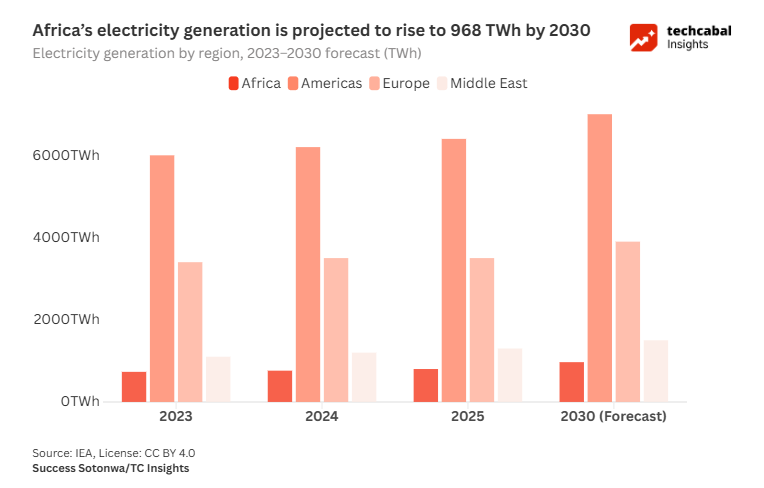
Africa’s AI sovereignty challenge is, at its core, an energy challenge wearing a technological disguise. The sequence is straightforward: reliable power underpins data centres. Without data centres, there is no sovereign compute. Without sovereign compute, Africa cedes leverage to foreign investors, foreign governments, and algorithms that increasingly decide who gets credit, who gets diagnosed, and who gets heard.
For Africa to be truly sovereign in the age of AI, it must address the foundational problem of energy sufficiency. Progress made elsewhere, welcome as it is, cannot substitute for this. Any attempt at leapfrogging merely postpones this inevitable conclusion.