


Africa’s startup ecosystem has officially raised $1.3 billion as of Wednesday, June 3. From a very busy first five months of the year, the ecosystem is showing incredible speed in just 3 days into June. This is a clear sign that even with a tough global economy, investors still have a strong interest in African innovation.
The H1 race: 2025 vs. 2026
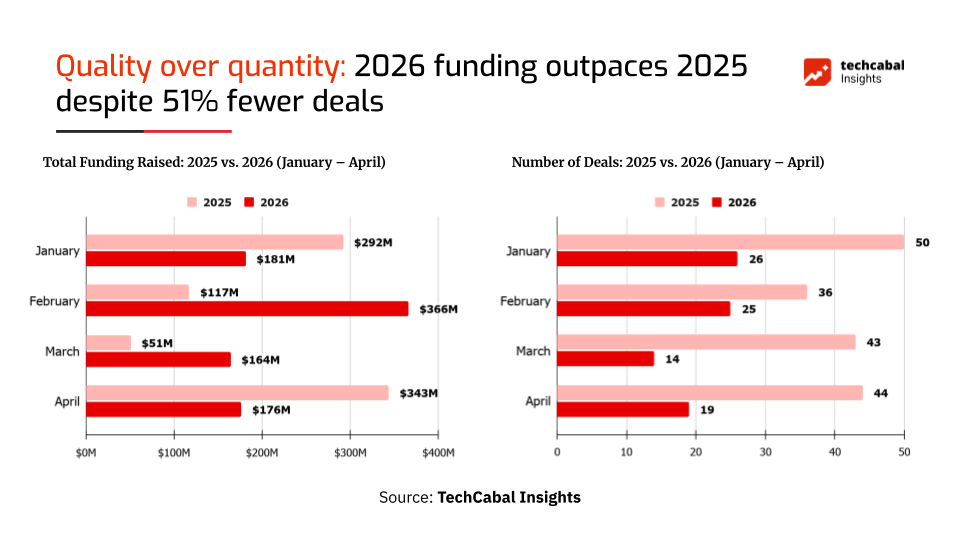
This year is proving to be a story of resilience. At this same time last year (January-May 2025), we tracked $1.056B. This year, we are very close to that pace with $1.044B raised so far.
The most exciting part is the final stretch of the first half of the year. In the first half of 2025, startups raised a total of $1.42B. June 2026 has already kicked off with its first massive mega deal, with Spiro raising $215M on the first day of the month. This injection pushes the current 2026 total to $1.3B. With about 27 days left until the end of H1 2026, the ecosystem needs just $121M more to surpass last year’s entire first-half record.
We will share the answer to the above question in our upcoming State of Tech in Africa H1 2026 Report. The data changes every day, so make sure to join the waitlist to see the final results.
[Join the H1 2026 Report Waitlist Here]
May’s top deals: Fintech and logistics lead the way
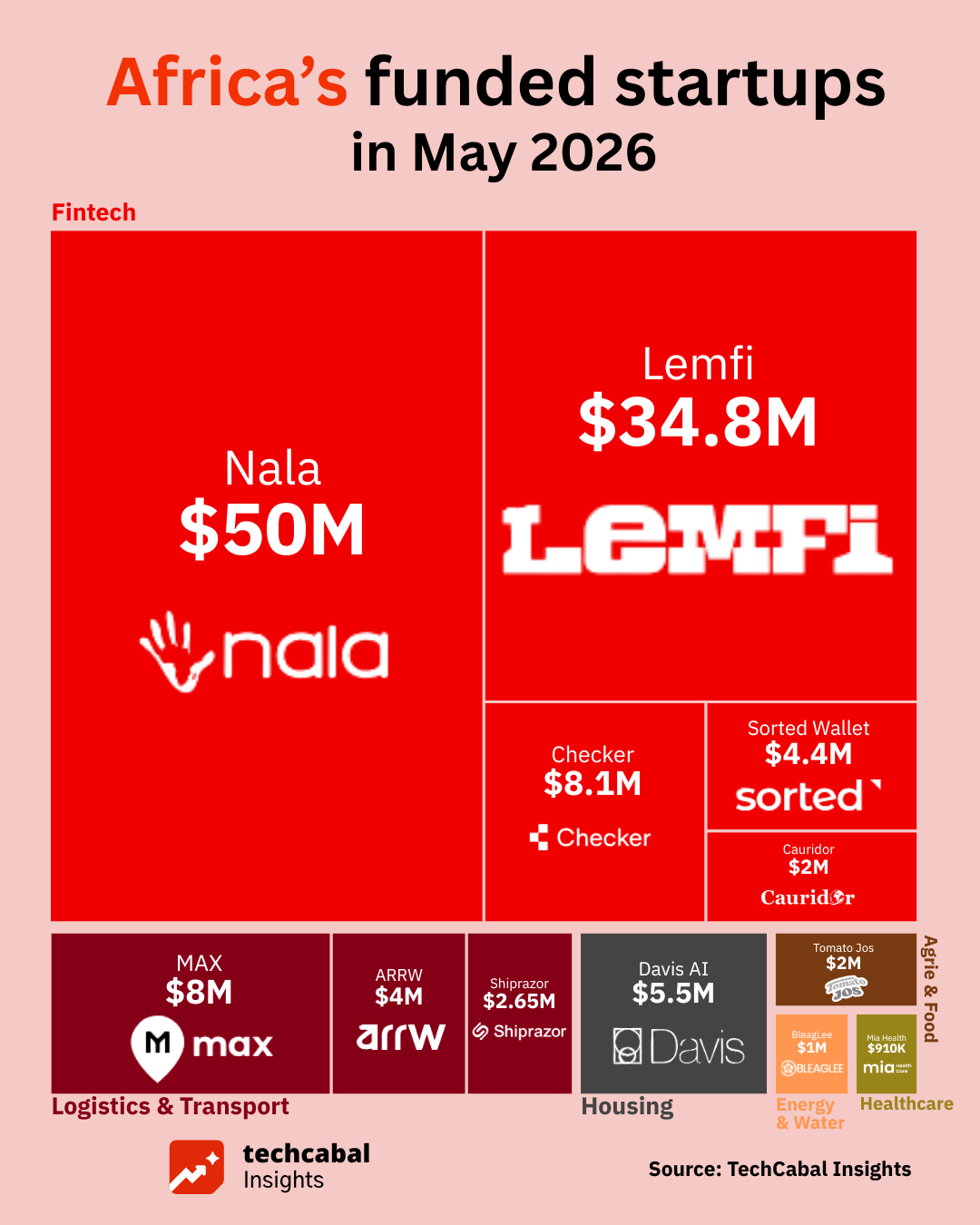
May 2026 added $124M to the total figure raised, with a mix of large loans and equity investments.
The month was led by Nala, a Tanzanian-based stablecoin payments infrastructure company, which secured a $50M loan to grow its cross-border payment systems. LemFi is also in the middle of a $34.8M (30 million Euro) investment round to expand its financial services for immigrants. In the transport sector, MAX raised $8M in debt to grow its electric vehicle fleet and battery-swap stations.
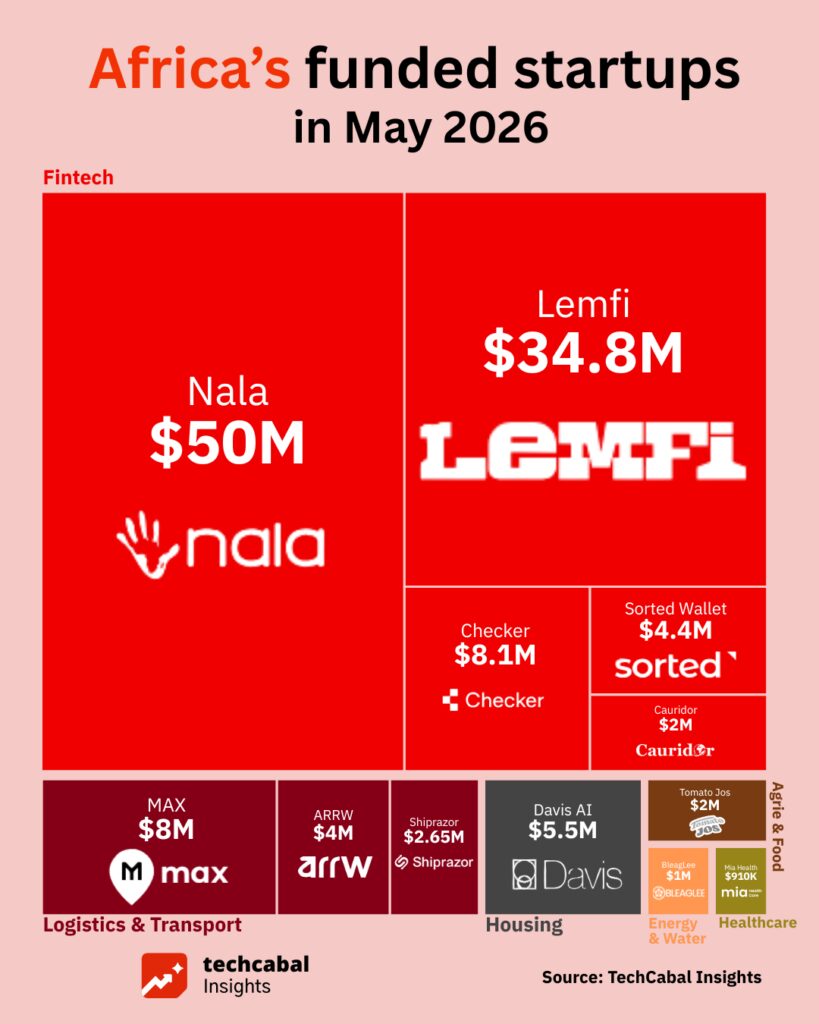
Other notable deals included Davis AI’s $5.5M round in Morocco, and South African logistics technology startup Shiprazor securing $2.65M in seed funding to address one of Africa’s most persistent barriers to e-commerce growth.
Beyond the funding: M&A, pivots, and global ambition
While funding gets the most attention, there are big changes happening behind the scenes. So far in 2026, we have tracked over 50 acquisition deals (mergers and acquisitions) worth more than $100M in total. Along with these sales, we are seeing more companies change their business models or pivot to stay sustainable.
We are also seeing more pan-African expansion. Companies are no longer just moving into neighboring countries; many are now expanding to markets outside of Africa. Our H1 2026 report will show the full map of where these companies are going and how these acquisitions are changing the market.
The AI reality: Better tools, fewer jobs?
To address the elephant in the room: Artificial Intelligence (AI) is now a core part of how African tech operates. We have tracked over 100 different use cases for AI across the continent. Builders are using AI to solve major problems in credit scoring, fraud detection, and customer support. It is helping companies work faster and cheaper by assisting with note-taking, generating ideas, and reducing manual errors.
However, this increased efficiency comes at a high human cost. As AI matures, it is moving from a ‘productivity tool’ to a ‘replacement tool’ for specific roles within Africa’s digital economy. The impact is already visible in the numbers: so far in 2026, we have tracked over 1,000+ layoffs across the continent, a sharp increase from the 698 layoffs recorded during the same period in 2025.
Notably, these are no longer just market corrections due to inflation; companies are now explicitly citing AI as the driver. From Jumia cutting 200 jobs to integrate AI into logistics and support, to Zap Africa reducing its workforce by 44% through an AI-driven restructuring, the trend is clear: a few companies are becoming smaller and more automated.