

Nigeria’s cross-border payments are gaining new rails, from stablecoins and regional payment systems to experiments with tokenised central-bank money. But new rails do not remove the need for firms that can connect them to businesses and people.
For most Nigerian businesses, sending money abroad still means passing through several banks before it reaches its destination. That is because a cross-border payment involves more than the movement of money. Banks must navigate correspondent relationships, different regulatory and compliance requirements, currency conversion, liquidity and different payment systems across jurisdictions. These can add fees, delays, and points at which a transaction can fail. Correspondent banking remains the main route, but alternatives are gaining ground.
Three new routes for cross-border payments
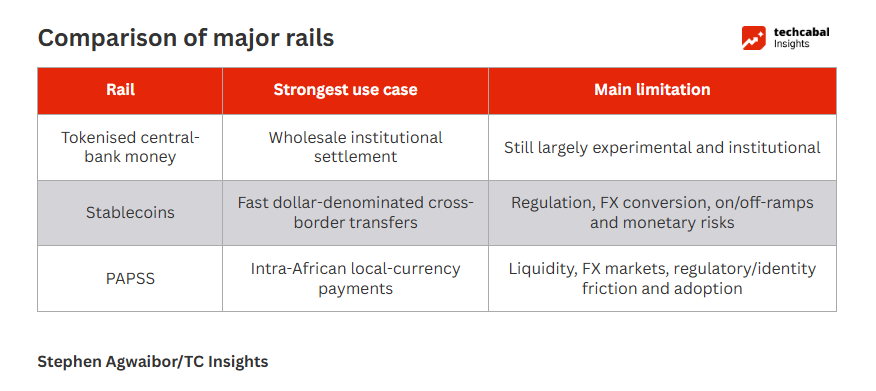
These rails are not interchangeable; each addresses a different part of the cross-border payments problem while still carrying its own limitations.
Tokenised Central Bank Money
Central bank digital currencies (CBDCs) are digital forms of money issued by a central bank. In wholesale systems, banks can use CBDCs or tokenised central-bank money to settle directly with one another.
Project mBridge, led by the Bank for International Settlements (BIS) and five central bank partners, reached a minimum viable product in 2024, after which the BIS handed it over to its partners. Project Agorá, another BIS-led experiment, is testing a shared platform for tokenised central-bank reserves and commercial-bank deposits. In July 2026, 28 financial institutions and central banks completed real-value transactions worth about CHF800,000 ($993,000), with settlement taking an average of about 80 seconds. However, these are still primarily institutional experiments. While they could change how banks and other financial institutions settle cross-border payments, they are not yet a payment rail that most Nigerian businesses can access directly. They’d still need to interact with a bank or another financial intermediary.
Stablecoins
Stablecoins are taking a different route. These are digital tokens designed to maintain a stable value, usually against a currency such as the US dollar. They are already being used at scale in Nigeria. The International Monetary Fund estimates that Nigeria received about $59 billion in crypto-asset inflows between July 2023 and June 2024. Stablecoins accounted for more than 65% of Nigeria’s cross-border crypto inflows in 2024. Nigeria also accounts for roughly 60% of stablecoin inflows into sub-Saharan Africa.
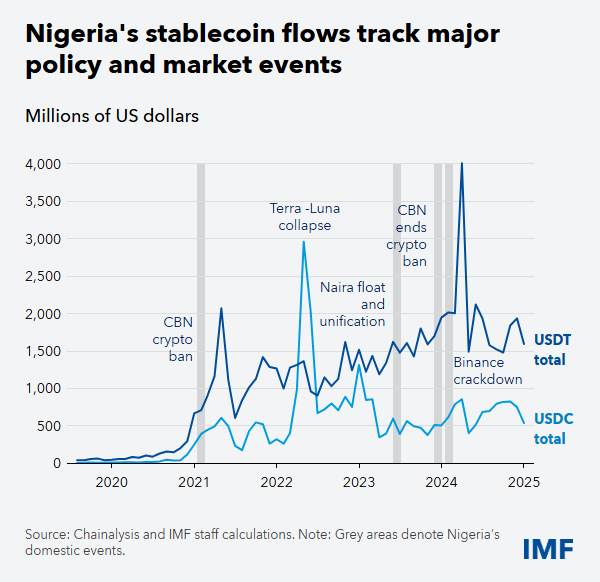
But stablecoins shift some of the problem rather than eliminating it. Users still need reliable ways to convert between naira, stablecoins, and other currencies, while regulators must address risks related to financial stability, money laundering, and the growing use of dollar-denominated digital assets. Nonetheless, their appeal is simple: a dollar-denominated token can move across borders without relying on the same chain of banks used for a conventional transfer. The cost advantage can also be significant. Sending $200 to sub-Saharan Africa costs about 9% on average, compared with 6% globally, according to the IMF.
PAPSS
The third route is regional payment infrastructure. The Pan-African Payment and Settlement System (PAPSS) allows participating banks and payment providers to settle eligible cross-border transactions in African currencies. Its network expanded to 28 countries, more than 190 banks and fintechs, and 16 switches after the Bank of Central African States joined in July 2026.
However, infrastructure does not guarantee use. Nigeria processed ₦5.6 billion through PAPSS in the first half of 2025, down 53% from the same period a year earlier. Transaction count also fell by 29%. Existential bottlenecks around verification, uneven adoption, and compliance delays may be contributory factors to the decline. The lesson is that while a new rail can reduce the number of intermediaries, it still needs liquidity, participating institutions and customers who trust it.
Someone still has to deliver the money
Nigeria’s regulator is now trying to make these systems work together. The Central Bank of Nigeria’s Payments System Vision 2028, published in June 2026, puts interoperability and stronger cross-border integration at the centre of its payments strategy.
For a business, however, the question is rarely which payment rail is technologically superior. It is which route works for a particular transaction. A Nigerian company paying a supplier in another African country may be able to use PAPSS and settle in local currency. The same company paying a supplier in China may need a dollar-based route. If it needs to move dollar value quickly between counterparties, a stablecoin may be another option, depending on the parties, regulatory requirements and available conversion channels.
That means businesses may end up using several rails rather than choosing one winner. The intermediary that can route each payment through the appropriate system, handle currency conversion and compliance requirements, and reliably deliver the funds can become as important as the underlying infrastructure.
Grey offers one example. Its business platform combines US dollar accounts with stablecoin transactions and international payouts. Within four months of launching, Grey Business reported $61.4 million in total payment volume. Stablecoins accounted for the largest share of its cross-border volume, while Nigeria led by transaction count. Western Europe and the Middle East led by transaction value.
Those numbers suggest something important about where the market is heading. Businesses are not choosing one payment system and abandoning the others. They need access to dollars, local currency, stablecoins and bank accounts, depending on the transaction. The useful service is therefore less about owning a single rail than about reliably connecting several of them.
As cross-border payments become more fragmented, the competitive advantage lies in making that complexity invisible to the business on the other side of the transaction.