


By Uche Aniche
For nearly two decades, the dominant model of innovation ecosystem development has been city-centric.
Silicon Valley. New York. London. Shenzhen.
In Africa, the equivalents became Lagos, Nairobi, Cape Town, Cairo, and Johannesburg. The assumption behind all of them is the same: innovation concentrates, talent clusters, and capital follow density. The strongest ecosystems emerge around a single dominant urban centre.
But what if that search has been looking in the wrong direction entirely? New data from Southern Nigeria suggests the next major innovation ecosystem on the continent may not be a city at all. It may be a corridor.
The Report Findings
The South-South & South-East Startup Ecosystem & State of Digital Jobs Report 2025, published by StartupSouth, mapped 304 startups, 98 Enterprise Support Organisations (ESOs), and startup activity across eleven states in Southern Nigeria. Its most striking finding was not startup growth. It was geography.
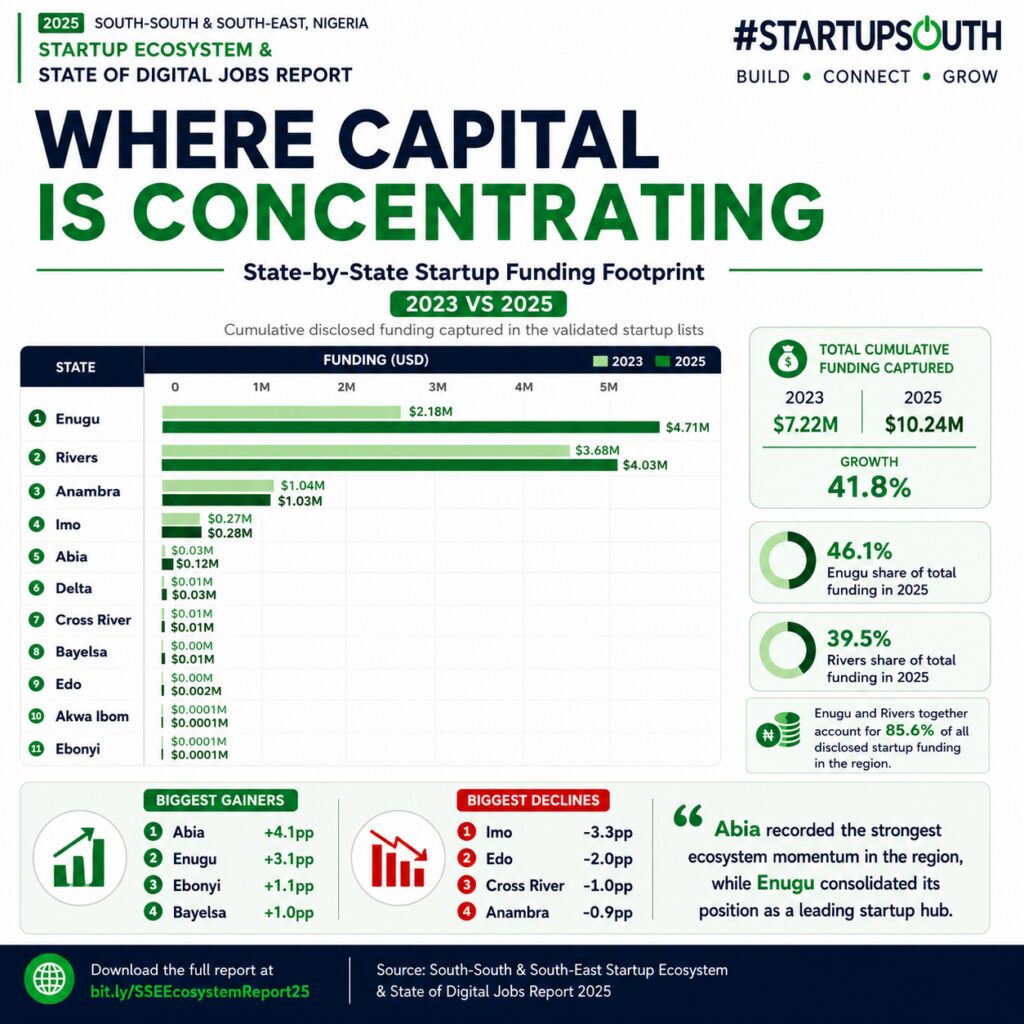
Rather than concentrating around a single dominant hub, the ecosystem it documents is distributed across multiple interconnected cities. Port Harcourt leads in startup volume. Enugu leads in capital raised. Aba is one of the fastest-rising ecosystem nodes. Nsukka is emerging through university-linked talent development. Yenagoa and Abakaliki are becoming visible. Awka, Owerri, Umuahia, Uyo, Asaba, Warri, Calabar and Benin City all play distinct roles. Individually, none of these cities resembles Lagos. Collectively, they may represent something more interesting.
The Geography of Proximity
Consider the geography more carefully.
Port Harcourt sits roughly 60 kilometres from Aba. Aba is less than 60 kilometres from Umuahia. Owerri lies within roughly 100 kilometres of both Aba and Onitsha. Awka and Onitsha are separated by less than 40 kilometres. Enugu connects to Awka and Nsukka through relatively short travel corridors. Uyo, Calabar, Yenagoa and Port Harcourt form another connected arc across the South-South.
This matters because ecosystems are ultimately networks. Talent moves between cities. Founders follow opportunity. Capital and customers are not confined by city limits. The traditional startup-city model assumes that all these interactions must take place within a single urban centre. Southern Nigeria increasingly suggests they do not have to.
A Model for The Continent
Aba contributes to manufacturing culture and entrepreneurial density. Onitsha contributes to commercial scale. Nsukka contributes university-driven talent pipelines. Enugu offers startup infrastructure, capital visibility, and one of the region’s strongest concentrations of higher education institutions. Port Harcourt adds corporate presence, technical talent, energy-sector adjacency, and the region’s highest startup volume. Together, they create something larger than the sum of their parts. This possibility matters beyond Southern Nigeria. Most African countries do not have multiple Lagos-sized cities, and many never will. Yet across the continent, clusters of medium-sized cities are linked through trade routes, universities, infrastructure, and cultural networks. Many African regions, in other words, already look more like corridors than cities.
The concept of the growth corridor is not new. Development economists and infrastructure planners have long used it as a framework for regional development, and the African Development Corridors Database documents dozens of such corridors built around transport, trade, and industrial connectivity. What has received far less attention is what an innovation corridor might look like.
What Corridors Solve
Corridors may address some of the structural weaknesses that concentrated ecosystems struggle with. Distributed across multiple nodes, they spread opportunity more broadly, reduce pressure on a single city, allow different locations to specialise, and expand both talent pools and effective markets. Critically, they make an ecosystem’s fortunes less dependent on the success or failure of any one urban centre.
This shift arrives at an important moment. Most global narratives about African startups still revolve around a handful of cities — Lagos, Nairobi, Cape Town, Cairo — yet beneath those headline ecosystems, new patterns are emerging. StartupBlink’s rankings now include multiple Nigerian cities beyond Lagos: Abuja, Ibadan, Enugu, Port Harcourt, Kano, Kaduna, and Benin City. The significance is not merely that more cities are appearing on ranking tables. It is that startup activity is becoming structurally distributed.
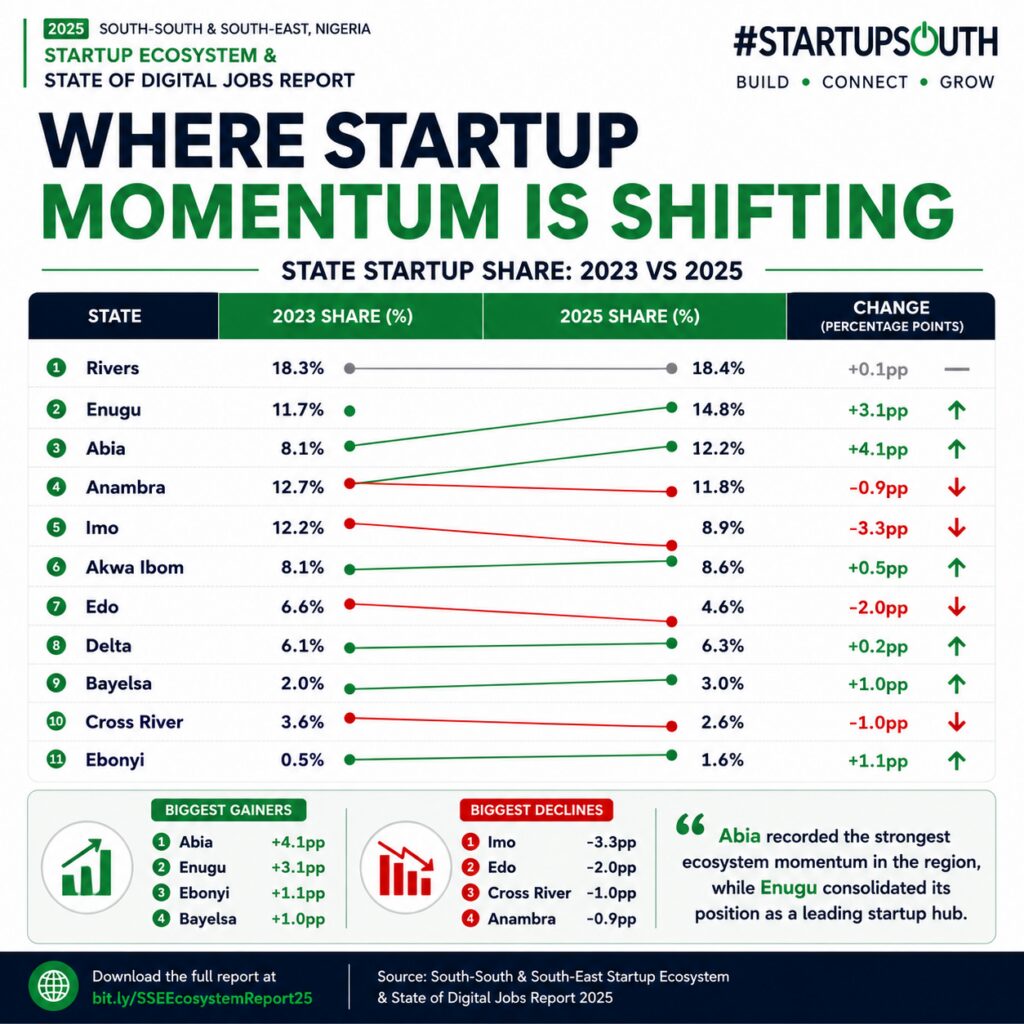
Between 2023 and 2025, startup activity across the South-South and South-East grew by 54.3%. The ecosystem now spans 304 mapped startups across eleven states. The South-East overtook the South-South in startup share for the first time. Abia recorded one of the strongest momentum shifts in the dataset. Growth is no longer confined to a handful of obvious locations. The ecosystem is spreading — unevenly, imperfectly, but measurably.
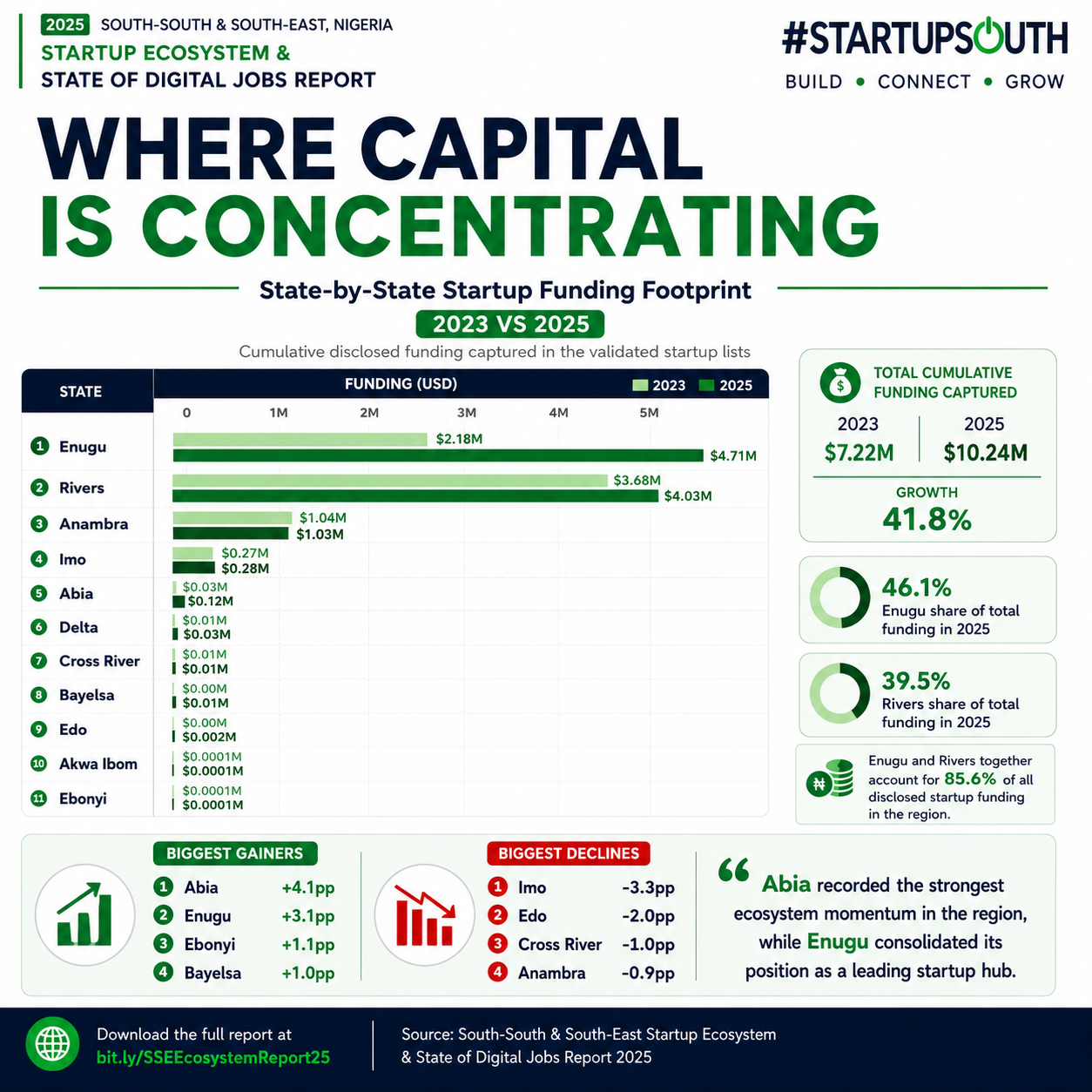
The supporting infrastructure is spreading alongside it. The region now hosts 98 mapped ESOs. Surveyed digital talent grew by more than 60% between reporting cycles. Total disclosed startup funding crossed $10.2 million, a notable figure given the difficult venture capital environment African startups have faced in recent years. More than half of surveyed startups now report receiving external funding, up significantly from 2023. These are not yet the metrics of a mature ecosystem, but they are the metrics of an emerging regional system.
Ecosystem Challenges Persist
However, Southern Nigeria has not solved its ecosystem challenges. Nearly 70% of digital talents are unemployed or freelancing. Most of those in remote employment work for companies outside the region entirely, meaning the corridor’s growth is generating activity without yet generating local economic retention. Funding remains heavily concentrated: six startups account for 86.6% of disclosed capital. EduTech, despite being the region’s largest startup sector by volume, attracted only around 1% of total funding — a misalignment that suggests the ecosystem is still being shaped by external investor preferences rather than local demand. The corridor is emerging, but it is not yet integrated.
The Way Ahead
What exists today is potential. Converting that potential to structure depends on whether founders, investors, policymakers, development partners, universities, and ecosystem builders begin to design for regional connectivity rather than individual city success. Because the next phase of African innovation may not be defined by which city wins. It may be defined by which regions learn to function as systems. For years, Africa has searched for its next Silicon Valley.
Southern Nigeria may be pointing toward a different future altogether. Not a city. A corridor.
Uche Aniche is the Founder of #StartupSouth and Convener of OffChart NXT. He leads research, ecosystem-building, and investment-readiness initiatives focused on Frontier African Cities, with a particular interest in how innovation ecosystems emerge, scale, and create economic opportunity beyond traditional technology hubs. He is the lead author of the South-South & South-East Startup Ecosystem & State of Digital Jobs Report 2025.