



In July, the International Monetary Fund (IMF) published Unlocking the Potential: AI in Sub-Saharan Africa. The 56-page paper argues that the region’s economy could grow by as much as 4% over the next decade. But that depends on overcoming longstanding constraints such as unreliable electricity and limited internet access.
The report applies a task-based exposure framework developed by Turkish-American Nobel laureate Daron Acemoglu. It estimates how much AI could raise productivity across Sub-Saharan Africa. The model was originally designed for the US and European labour markets. However, the authors acknowledge that it may not fit Sub-Saharan Africa perfectly. This is because the task bundles that define a given job, and the underlying data used to classify them, don’t necessarily map cleanly onto how those same jobs are structured in Sub-Saharan Africa.
In a subsequent Reuters brief, lead author Martin Schindler warned that AI may add only 0.2% to GDP over the coming decade. He described that outcome as a “rounding error.”
Only under a best-case scenario, where electricity, connectivity and digital infrastructure improve substantially, could that figure rise to roughly 4%.
What explains this divergence? The answer lies not in AI itself, but in the economy into which it is being introduced.
Why the starting number is so low
The IMF sorts jobs into three buckets. Some have low exposure to AI. In others, AI complements workers by making them more productive. In the third group, AI replaces tasks that workers once performed. The picture in Sub-Saharan Africa looks very different. As the report highlights, 77.3% of jobs fall into the low-exposure bucket, the highest share of any region tracked. Europe, by comparison, has 43.8% of jobs in that bucket.
This is a mixed blessing. On one hand, far fewer African jobs face near-term automation than jobs in Europe or America. On the other hand, fewer jobs stand to benefit from the productivity gains AI can deliver. TechCabal Insights’ own layoff database reinforces this point. Across 56 layoff events over the past three years, companies almost never cited AI as a direct cause. This is because, according to the International Labour Organisation, at least 85% of employment in Sub-Saharan Africa is informal. Most of those jobs fall within agriculture, retail and manual services. That is, they rely on physical, context-specific tasks that remain outside the remit of today’s AI models.
History offers one vital lesson that the economic benefits of general-purpose technologies take time to materialise. We can see this exemplified with electricity, which is perhaps the clearest historical parallel. Although factories began adopting electric motors in the late nineteenth century, productivity barely moved for years. Manufacturers simply replaced steam engines with electric motors while leaving factories organised around older operating models. Only after production itself was redesigned to exploit electricity’s flexibility did productivity accelerate.
As Africa’s own electricity story shows, this matters. Nearly two centuries after the advent of the alternating current, about 600 million Africans still lack access to electricity. According to the International Energy Agency, achieving universal access by 2035 will require around $15 billion in annual investment.
Computers followed a similar path. In 1987, the economist Robert Solow observed that “you can see the computer age everywhere but in the productivity statistics.” Economists later called this the productivity paradox. Better computers alone did not solve it. Businesses unlocked productivity by adopting new software, management practices and workflows.
Much closer to home, we can examine Africa’s mobile revolution. The technology began to transform economies only after it spread widely. Widespread adoption created entirely new markets and services. A 2023 World Bank paper found that expanding mobile phone access reduced price dispersion in agricultural markets by lowering search costs. Mobile broadband also strengthened financial inclusion and increased women’s labour force participation. Importantly, it paved the way for one of Africa’s biggest success stories: mobile money.
The IMF’s own data on general-purpose technology in Africa traces the technological adoption curve. Electricity took over 40 years to reach a fraction of the population that mobile phones and the internet reached within 15, because the constraints were never really about the technology itself. General-purpose technologies do not transform economies on arrival. They transform them once complementary investments and large-scale readjustments are made in the way people work. Economists sometimes describe this as the capacity to absorb new technologies. In practice, it is the combination of infrastructure, skills, institutions and organisational change that allows innovation to translate into sustained growth.
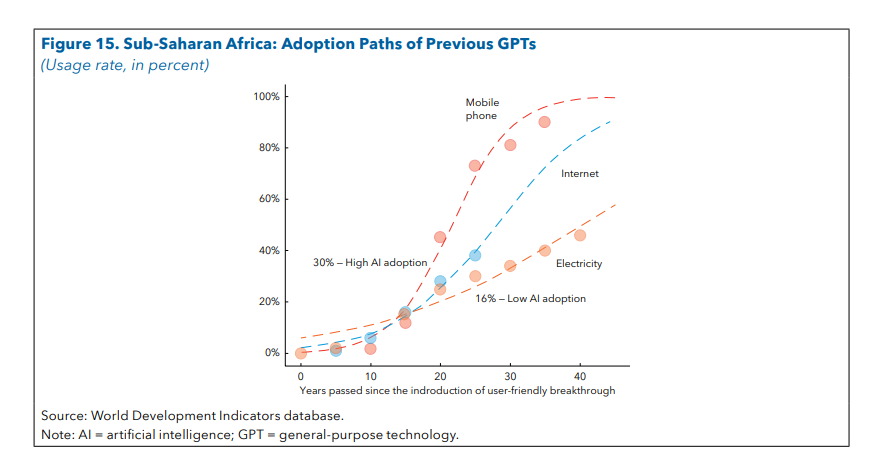
Seen in this light, the IMF’s forecast tells us less about AI’s capabilities than about Africa’s current ability to put the technology to productive use. Under today’s conditions, that translates into a GDP of just 0.2% over a decade for Sub-Saharan Africa, compared with around 1% for Europe. The estimate is deliberately conservative, assuming today’s infrastructure, adoption rates and occupational structure remain largely unchanged.
The four things standing in the way
The IMF identifies four structural constraints that determine whether AI moves beyond isolated pilots and into economy-wide productivity. Without progress on these fronts, the technology’s economic impact will remain limited, regardless of how rapidly AI itself improves.
The report cites real progress on some fronts. Yet, not all of them have held up. Take the Microsoft and G42’s $1 billion geothermal-powered data centre campus in Kenya, which the report champions. It has since stalled due to power constraints, highlighting the limits of African AI sovereignty. Off-grid solar, a growing trend that has helped expand the region’s renewable capacity, doesn’t fare better in the IMF’s own assessment, which calls it “unlikely to be sufficient” at the data-centre scale.
Human capital presents a similar challenge. Countries with stronger AI ecosystems continue attracting scarce technical talent, while those with weaker ecosystems struggle to retain the specialists needed to build their own capabilities. The result is a widening gap in AI readiness, where early advantages reinforce themselves over time.
On compute access, Cassava Technologies and NVIDIA’s $700 million deal to deploy 12,000 GPUs across five countries, and the IFC’s $100 million commitment to Raxio’s facilities in Ethiopia, Angola, Mozambique and Côte d’Ivoire are well-documented. The data centre construction pipeline is at $3 billion or more through the early 2030s, with South Africa, Nigeria, Kenya and Egypt absorbing most of it.
Yet the scale remains tiny by global standards. Africa has around 160 data centres for its 54 member nations, roughly 5.5% of global installations, and nearly half of these are concentrated in just three countries: South Africa, Nigeria and Kenya. A majority of them are not yet suited for AI use. Even with ambitious plans for the future, the IMF estimates that the continent’s AI data centre capacity will remain under 1% of the global total by 2035.
Where AI is already delivering results
The encouraging news is that AI is already delivering visible benefits across agriculture, education and healthcare. These examples matter because they demonstrate that the constraint is rarely the technology itself. Where complementary infrastructure, data and institutional support exist, AI is already improving outcomes. The challenge is extending those gains beyond isolated successes and into the wider economy.
In agriculture, Farmerline’s Darli AI serves smallholders in 27 languages, including 20 African ones, and the report cites farmers being 60% more likely to adopt new techniques when advice arrives in their own language. Senegal’s Tolbi has cut irrigation water use by up to 60% using machine learning. South Africa’s Aerobotics uses AI-powered drones to lift crop yields by 15% while cutting pesticide use by the same margin. Across randomised trials in Nigeria, Ghana, Rwanda, Kenya and Uganda, digital advisory tools lifted yields by up to 15%, and by 20 to 30% when paired with better inputs.
TechCabal Insights, in its policy brief, highlighted how a six-week chatbot tutoring pilot in Nigerian secondary schools led to learning improvements equivalent to roughly two years of schooling. In Kenya, an AI-based clinical decision support tool cut diagnostic errors by 16% and treatment errors by 13% across nearly 40,000 patient visits. These are promising developments that require deliberate policy action to sustain and scale.
What it would take to reach 4%
The optimistic scenario in which AI contributes 4% to Africa’s GDP rests on a series of policy levers. Knowing which lever does the most work matters for anyone deciding where to focus capital or attention.
Starting from today’s 0.2% baseline, expanding AI into sectors currently classified as low exposure adds 0.3 percentage points. Raising adoption rates to levels seen in Europe and the Western Hemisphere contributes another 0.8 points. Extending AI to agriculture adds an additional 0.8 points. But the largest gain comes from capital investment, leading to positive spillover effects. Data centres, devices and complementary digital infrastructure account for 1.9 percentage points on their own. In other words, the biggest uplift comes not from better AI models, but from investing in the capital that allows firms to use them effectively.
The IMF recommends specific interventions. These include better grids, cheaper data, agricultural extension tools, and the financing to build AI-related capital in the first place.
What is unclear is where that money will come from or who will pay for it. Last year, the African Development Bank (AfDB) announced a $60bn tech fund to support AI in Africa. But the details around that fund are vanishingly thin. In February 2026, it announced a separate partnership to mobilise $10bn at the Nairobi AI forum. It remains to be seen if anything substantial materialises from it. Stephen Deng, Co-founder & Partner at Africa-focused investment firm, DFS Lab, raised this concern in response to the paper. In his words, calling for a revolution in long-tail AI use while naming venture capital as a core funder, without ever addressing ability and willingness to pay, “is simply promoting the more efficient distribution of fragility.”
Who actually captures the gains
AI gains won’t be evenly distributed across the continent due to disparate levels of investment and across sectors due to the lag in technological adoption, as explained earlier. Two groups are best positioned to benefit first: high-skill workers in finance, professional services and ICT, where AI is easiest to deploy, and the handful of economies (South Africa, Nigeria, Kenya, plus Mauritius, Botswana and Namibia) that already host most of the region’s data centres, venture capital and digital infrastructure. Egypt, Kenya, Nigeria and South Africa alone absorbed 84% of the roughly $2.2 billion in AI-related venture funding that flowed into the continent last year.
At present, however, large sections of the population remain out of reach of these benefits. These include small informal firms without the power or capital to integrate AI, rural households still priced out of connectivity, and countries whose weaker infrastructure deepens their dependence on foreign compute, providers and governance frameworks.
The uneven distribution of these benefits also suggests that closing Africa’s AI gap is not simply about raising average adoption. It is about broadening access so that productivity gains spread across firms, regions and sectors rather than remaining concentrated in a handful of countries and industries.
The takeaway
The IMF’s 0.2% estimate can easily pass as a verdict on Africa’s AI prospects. My sense is that it’s better read as a diagnosis of the economy AI is entering, one where, as history’s general-purpose technologies keep showing, productivity lags diffusion until the surrounding system catches up.
Whether the continent ends the next decade closer to 0.2% or 4% will depend on reliable power, affordable connectivity, sustained investment in skills and digital infrastructure, and institutions capable of supporting technological change. The IMF’s numbers are ultimately a reminder that technology alone does not transform economies. It becomes productive only when businesses, workers and institutions adapt around it. That is the hard work that still lies ahead.