


Africa’s mobile sector contributed $220 billion to the continent’s economy in 2024, 7.7% of GDP, supporting 8 million formal jobs and generating over $30 billion in annual taxes. Now, a new class of offshore satellite operators is competing for the same high-value customers while bypassing the licensing costs, infrastructure obligations, and tax regimes that underpin that entire ecosystem.
A report from the Africa CEO Forum and Askya Investment Partners asks an uncomfortable question: who actually controls Africa’s connectivity future?
The divide isn’t about coverage anymore
Africa’s digital divide has shifted. By December 2024, mobile coverage had reached roughly 88.4% of the population, meaning almost everyone lived within reach of a signal. Yet only about 416 million people were active internet users. The gap isn’t just about signal, but about affordability. MTN Nigeria’s CEO Karl Toriola has been blunt about this, claiming that unlimited data bundles “don’t exist” and cost a fortune.
Low Earth Orbit (LEO) satellite services, such as SpaceX’s Starlink, were expected to bridge that gap. Instead, the report finds they are targeting high-value urban and enterprise customers, the very segments whose revenues have historically subsidised rural network expansion.
The pricing data tells the story. Even after recent cuts, Starlink hardware costs between $200 and $400, with monthly fees of $30 to $110. The actual customer base consists largely of small businesses, NGOs, affluent households, schools, and government facilities. It is not a structural solution to mass digital exclusion.
A deeply uneven playing field
The competitive asymmetry extends beyond pricing and into licensing. In Senegal, the traditional operator Sonatel paid over $50 million for a 5G licence. Starlink paid $150,000 for its licence, yet both compete for the same enterprise customers.
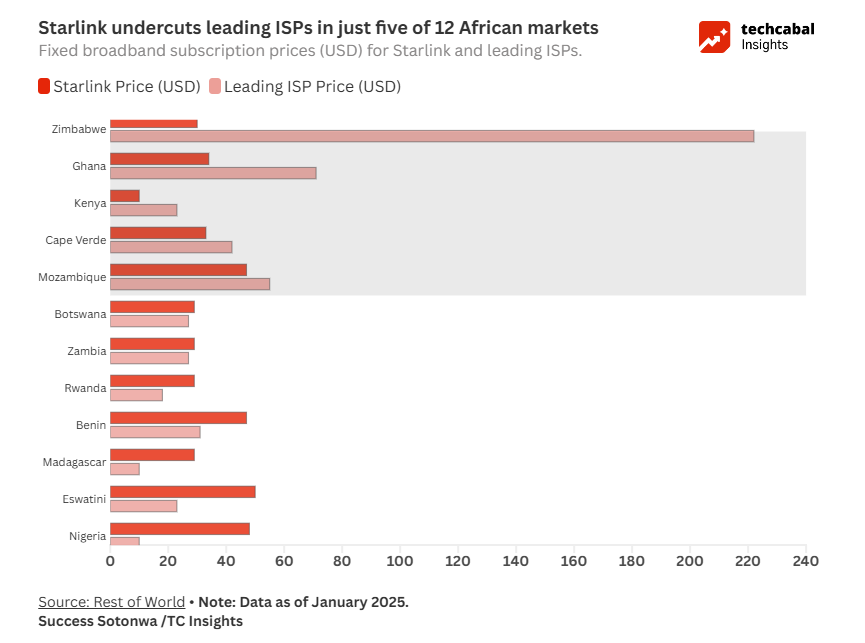
Meanwhile, African mobile operators are expected to invest $77 billion in networks between 2024 and 2030, according to the GSMA. That investment depends on retaining the high-value customers satellite providers are now actively targeting. However, Starlink’s price advantage is not universal. Across 12 African markets surveyed in January 2025, Starlink undercut leading ISPs in only 5 markets, with local providers remaining cheaper in countries such as Rwanda, Benin, and Nigeria.
Starlink’s growth across the continent remains modest but accelerating. In Zimbabwe, subscriptions grew to 67,057 in Q4 2025, a 31.6% increase from Q3, making it Starlink’s fastest-growing African market. In Kenya, it reached 22,282 subscribers by December 2025, its highest since launch, yet still ranks eighth among the country’s internet service providers. For context: Safaricom added more new users in a single quarter than Starlink’s entire Kenyan subscriber base.
[Join the H1 2026 SOTIA Report Waitlist Here]
Competition is coming, and it’s not African
Starlink is no longer the only player. Amazon secured a seven-year landing permit from Nigeria’s communications regulator in early 2026 to launch its Project Kuiper satellite broadband service. In April, Amazon filed for an operating licence in Kenya and plans to deploy a constellation of more than 3,200 satellites by 2028.
Two US-based offshore operators competing for Africa’s most valuable connectivity customers, with minimal local presence between them, is precisely the scenario the report warns against.
Starlink has delivered some benefits, and the partnership model is evolving
To its credit, Starlink’s entry into Nigeria and Kenya coincided with more aggressive pricing and service improvements from incumbents. Competition has had real effects.
The partnership dynamic is also shifting. Airtel Africa signed a strategic agreement with SpaceX in December 2025 to deploy Starlink’s Direct-to-Cell technology across its 14 African markets, giving its 174 million customers satellite connectivity in areas without terrestrial coverage. That is a fundamentally different model from head-to-head competition with domestic operators.
Regulators are drawing different lines
Countries are responding in sharply different ways:
- Rwanda and Senegal have taken open, pragmatic approaches, fast-tracking licences and treating satellite as a complement to national broadband strategies.
- Nigeria and Zambia allowed entry within negotiated frameworks, with active regulatory scrutiny of pricing and market distortion.
- South Africa has blocked formal entry, citing Black Economic Empowerment ownership requirements. Over 32,500 South Africans participated in public consultations on the licensing question, a sign of how politically charged the issue has become.
- Namibia formally rejected Starlink’s licence and spectrum applications in March 2026, drawing the clearest line on the continent so far.
The bottom line
Traditional mobile networks are locked into heavy local taxes, strict job-creation targets, and billions in infrastructure commitments. Foreign satellite giants are entering the same markets, picking off the most profitable urban and business customers at a fraction of the regulatory cost.
If African regulators do not shift satellite providers from direct-to-consumer competitors into wholesale partners, they risk hollowing out the very domestic telecom industry that Africa’s digital economy relies on.